Number of Counties in California Explained – Full List & Map
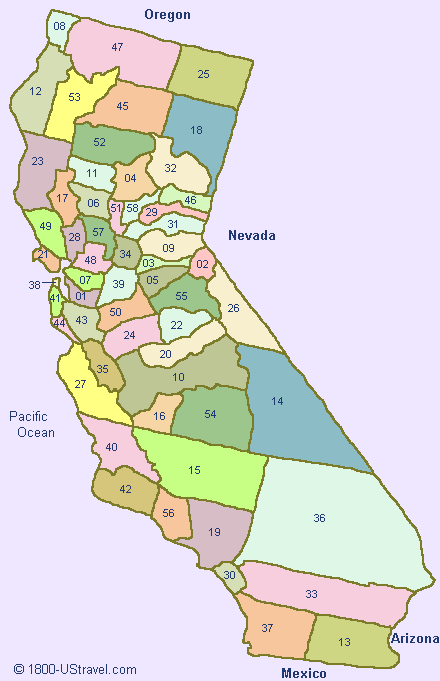
Have you ever wondered how many counties California actually has? You’re not alone. Be it for research, a road-trip map, or pub-quiz glory, the answer—58—comes up again and again, and stillthose two digitsis just the first layer of a deeper tale.
California’s counties forma patchwork of contrasts: surf-washed beach cities, pine-covered mountain regions, fruit-laden interior valleys, and thriving tech metropolises. Each county carries its own story, shaped byrailroad expansion, cutting-edge innovation, and ever-changing demographics.
In the sections ahead, we’ll explore why California ended up with 58 counties, the real responsibilities counties shoulder, and the record-holders—from the tiniest to the most populous. When we’re done, you’ll own the knowledge—and map your next California adventure with confidence.
How the Golden State Reached 58 Counties
Upon admission to the United States, the map contained barely half the jurisdictions we know now. A tidal wave of forty-niners and immigrants compelled legislators to carve out new counties. Before the century turned, the count had ballooned to over five dozen counties, and in 1907 the remaining gaps were closed, cementing the now-famous tally of 58.
Assembly journals reveal that fresh jurisdictions sprang out of a trio of factors:
- Sheer distance turned routine business into week-long trips.
- Revenue battles splitting river towns from hinterlands triggered secession campaigns.
- Language and immigrant communities demanded tailored governance.
Within a single generation, the political map settled. Today, no proposal to add a 59th county has cleared committee, leaving historians to label the era when new counties sprouted decisively over.
Landscape and Climate Diversity Across California Counties
Stretch a string from the Smith River watershed to border-side Calexico, and you’ll traverse a climatic kaleidoscope. Ocean-brushed jurisdictions enjoy Mediterranean precipitation, while interior giants like San Bernardino or Kern battle drought cycles.
- Alpine districts such as Placer, Nevada, and Alpine receive winter snows.
- River-delta territories fight subsidence but export produce worldwide.
- Island counties like Santa Barbara oversee ferry routes.
Such variety explains how water rights, zoning, and ag yields diverge so sharply. Topography dictates everything from wage levels to weekend hobbies.
Behind the Scenes at the County Level
Within the state’s tiered system, municipalities handle zoning, but counties are tasked with vital “unseen” duties that make communities livable. Cradle-to-grave—marriage licenses, tax rolls, voter registries—all sit at the registrar of voters.
Sheriff’s departments patrol vast rural stretches, while trial courts hear probate battles. Social-services bureaus coordinate Medi-Cal. Budget battles occur in monthly Board of Supervisors sessions.
Case Study: Tiny Alpine County
Contra Costa partners with nearby cities for animal control, showing how elastic the system is. Uniformity would never work when budgets span five figures to double-digit billions.
At day’s close, county halls translate state statutes into daily action. Understanding their remit empowers voters.
Where the People and Money Are
Home to over 39 M souls, but the headcount is far from evenly spread. LA County by itself packs nearly 25 %. At the other extreme, tiny Alpine County hovers around a thousand residents.
- Most populous: Los Angeles
- Smallest by residents: Alpine County
- Largest area: San Bernardino County
- Smallest area: City & County of SF
Economically, the disparities are just as sharp. South Bay enclaves boast per-capita GDP rivaling small nations, while cotton-and-almond hubs battle mechanisation and drought cycles. This revenue gap fuels housing affordability crises every decade.
Tracking each superlativemakes relocation plans simpler: county borders redraw home-buying budgets and business licences.
The Ultimate California County Circuit
For intrepid travellers, setting foot in each CA county ranks as a top geo-challenge. One ambitious loop sets out in San Diego, heads north along Highway 1, jogs east near Big Sur, then zigzags across rice-field flats and orchard grids, before climbing into the granite spine for ghost towns and mining museums.
Breaking the Trip Into Segments
- Southern Swing – Mission trail coast; ten jurisdictions in four days.
- Valley Ribbon – Ventura to Sacramento; flat-land express.
- Shasta & Siskiyou Turn – crater-rim roads; hidden hot springs.
Cap off the circuit in the desert southeast, having logged 1 400–2 000 miles. By then, you can confidently claim you know “how many counties California has”—because you’ve seen them all!
California County FAQ
Curious about California’s 58 counties? The following FAQ has you website covered.
How many counties are in California?
California officially recognises 58 counties—a total locked in for over a century. Whether you ask the Secretary of State, the Census Bureau, or a local historian: 58 in all.
Where do the most Californians live?
Los Angeles County tops the list, housing roughly one in four Californians. From Hollywood to high tech, a mix of industries continues to fuel steady inflow.
What is the smallest county in California by population?
Tiny Alpine County sits at the bottom of the population chart, with fewer than 1 200 inhabitants. Its remote Sierra setting naturally restricts settlement, preserving a frontier feel.
Which county covers the largest land area in California?
San Bernardino County spans the most ground covering a footprint larger than nine U.S. states. Its sheer scale means climate zones shift from alpine snow to Mojave heat within county lines.
Why does California have exactly 58 counties?
The current tally emerged from 19th-century partitioning, ending when Imperial County formed in 1907. Since then, proposals to add a 59th county have surfaced but never cleared the Legislature.
Is it possible to form a 59th county?
On paper, state statutes permit county formation, but the hurdles are steep. A break-off region must gather local signatures, win a majority vote in each affected county, and secure legislative approval. Consequently, boundaries have frozen for over a century.
Why are counties important to everyday life?
Counties handle the backbone of local governance: property assessments, public hospitals, welfare programs, and jails. Remove counties from the equation, and civil society would struggle to operate.